Not every connected product needs Wi-Fi, Bluetooth or a mobile data connection when LoRa is an option.
Sometimes the requirement is much simpler: send a relatively small amount of information, use very little power, cover a considerable distance and do it reliably without adding significant cost or infrastructure.
In those circumstances, LoRa can be a remarkably effective solution.
Long range without high power
LoRa — short for Long Range — is a low-power radio technology designed specifically for applications where relatively small amounts of data need to be transmitted over much greater distances than would normally be practical with technologies such as Bluetooth or Wi-Fi but it still enjoys the advantage of licence free operation.
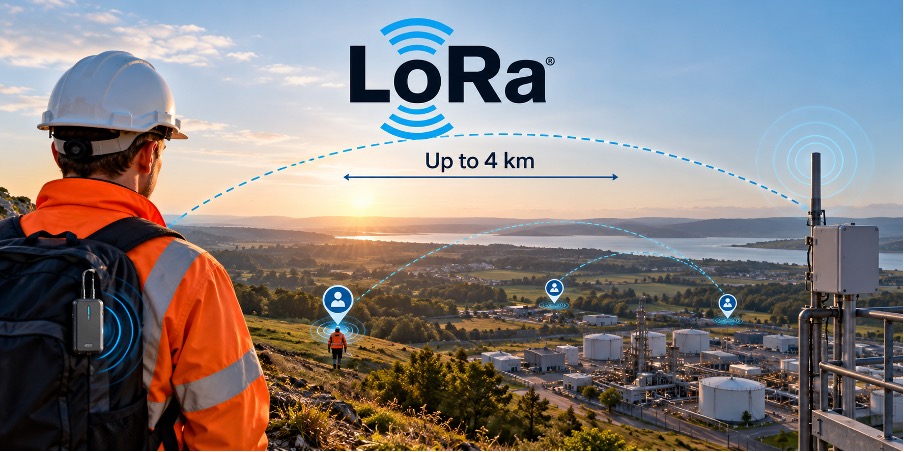
At Arrow Technical we have used LoRa in real applications and carried out our own range testing. Under suitable conditions, we have achieved reliable communication at distances of up to approximately 4 km at the full data rate.
That is an impressive distance for a small, low-cost radio module operating at very modest power levels.
Of course, radio range always depends upon the environment. Buildings, terrain, antenna positioning, interference and installation details all have an effect. But even where maximum range isn’t required, LoRa’s generous link budget can provide something equally valuable: robust communications at shorter distances in less-than-ideal conditions.
The trade-off is data rate
There is no magic involved. LoRa achieves its combination of range, robustness and low power consumption partly by accepting relatively low data rates.
If you need to stream video, audio or large quantities of data, LoRa is clearly the wrong technology.
But many electronic products don’t need to do that.
A remote sensor might only need to report a temperature, level, pressure, alarm condition or equipment status periodically. A control system may only need to transmit a few bytes to operate an actuator or confirm that something has happened.
For applications like these, sacrificing bandwidth that isn’t needed in exchange for greater range and lower power consumption can be an excellent engineering trade-off.
Designed for applications where batteries need to last
Low power consumption becomes particularly important when both ends of a wireless system need to operate from batteries.
Applications we have developed using LoRa where both parts needed to be battery powered, had a target operating life measured in years rather than days or weeks.
LoRa lends itself particularly well to these types of application. Devices can remain in very low-power states for much of the time, waking when necessary to exchange relatively small amounts of information before returning to sleep.
This can make applications practical where regularly changing or recharging batteries would be inconvenient, expensive or simply unrealistic.
Useful in difficult and hazardous environments
Low-power operation can have advantages beyond simply extending battery life.
It can also be particularly valuable when designing equipment for difficult or hazardous environments. In applications requiring intrinsically safe equipment, controlling the amount of electrical energy available within the equipment is a fundamental part of the design.
At Arrow Technical we are currently working on LoRa-based equipment for which intrinsic safety certification is required in several international regions. Certification is underway as the products are progressing through that process.
LoRa does not itself make a product intrinsically safe — the complete product electronic design, including its energy storage, circuitry, component selection, PCB design and construction, has to be designed and assessed accordingly.
However, the very low power requirements possible with LoRa can make it an attractive communications technology when developing battery-powered equipment for these demanding environments.
LoRa doesn’t necessarily mean LoRaWAN
LoRa and LoRaWAN are sometimes used as though they mean the same thing, but there is an important distinction.
LoRa is the underlying radio technology. LoRaWAN is a networking protocol built around it, allowing devices to communicate through gateways and potentially onwards to internet or cloud services.
For some applications LoRaWAN is exactly what is required.
For others, a much simpler direct LoRa point-to-point or local network may be preferable. If all that is required is for a handful of devices to communicate across a site, there may be little benefit in adding unnecessary network infrastructure or cloud services.
As always, the right solution depends upon what the product actually needs to do and Arrow Technical are experienced and well placed to advise how best to deploy it.
Choosing the technology to suit the problem
LoRa isn’t a replacement for Wi-Fi, Bluetooth, Matter, cellular communications or other wireless technologies. They each solve different problems.
But where the requirements include:
- relatively small amounts of data;
- very low power consumption;
- battery operating life potentially measured in years;
- long communication distances;
- robust operation;
- relatively low hardware cost; and
- little or no existing communications infrastructure,
LoRa deserves serious consideration.
The important part of designing a wireless product isn’t choosing the newest or most fashionable technology. It is choosing the technology whose characteristics best match the application.
At Arrow Technical, we have practical experience designing LoRa communications into electronic products — including battery-powered tracking systems, low-power product design and real-world long-range testing.
If you have a product that needs to communicate reliably over a significant distance — particularly where power, cost or the operating environment present additional constraints — send us the requirements and let our engineers take a look. LoRa may provide a much simpler solution than you expect.