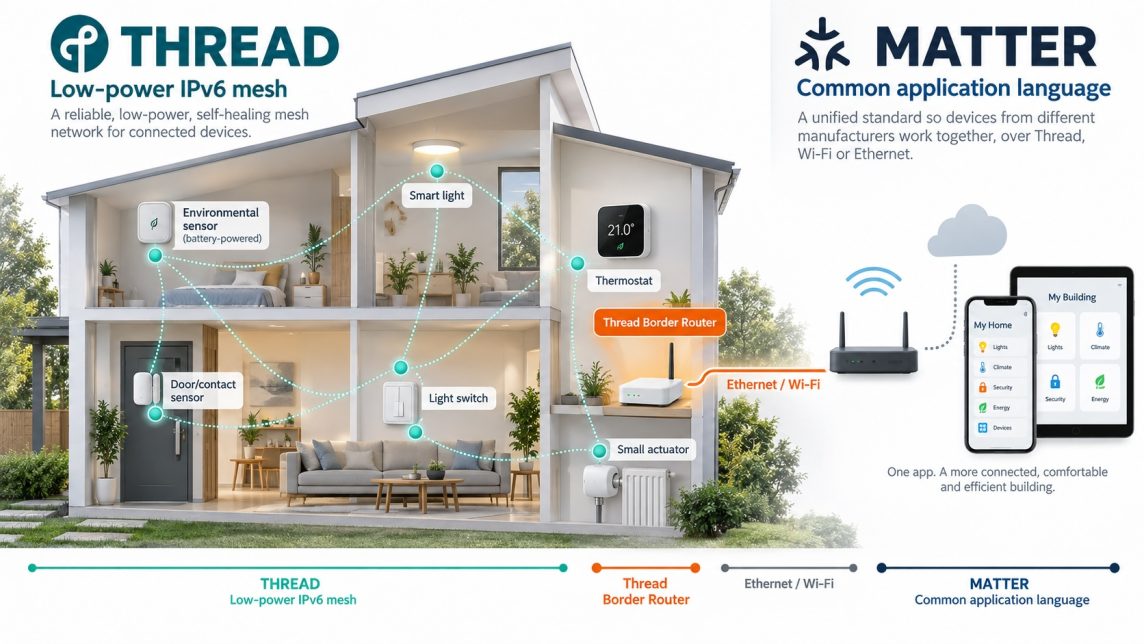
This article on Thread follows our recent article on Matter (Matter Article Link) where we looked at how manufacturers can develop connected products that work with established ecosystems such as Apple Home and Google Home, rather than having to develop the entire communications and user-interface infrastructure themselves.
But Matter is only part of the story.
Many Matter devices use a networking technology called Thread. Although the two are often mentioned together, Matter and Thread are not the same thing.
So what is Thread?
Thread is a low-power, wireless mesh networking technology designed specifically for connected devices such as sensors, switches, thermostats and actuators.
It uses the same 2.4GHz radio technology defined by IEEE 802.15.4 that is also used by technologies such as Zigbee, but there is an important difference: Thread is IP-based.
Every Thread device can therefore participate in an IPv6 network. Rather than requiring a proprietary gateway to translate between one communications protocol and another, Thread was designed from the outset to integrate with standard IP networks.
For product developers, that is potentially a significant advantage.
A mesh rather than a collection of Wi-Fi devices
Wi-Fi is excellent where relatively high data rates are required, but it is not necessarily the ideal solution for every sensor or actuator in a building.
A small temperature sensor, door contact or light switch might transmit only a few bytes occasionally. Providing each of these devices with a conventional Wi-Fi connection can be unnecessary in terms of power consumption and network overhead.
Thread takes a different approach.
Mains-powered Thread devices can form a mesh network, passing messages between devices and extending coverage through a building. Battery-powered devices can operate in a much lower-power mode and communicate through nearby Thread devices without having to remain continuously active.
This makes Thread particularly attractive for networks containing many relatively simple sensors and actuators.
What is a Thread Border Router?
A Thread network still needs a way of communicating with the rest of the IP network.
This is provided by a Thread Border Router.
The Border Router connects the Thread mesh to the normal Ethernet or Wi-Fi network. Importantly, this does not necessarily mean that a manufacturer has to supply another dedicated box.
Thread Border Router functionality is already incorporated into a growing range of consumer and commercial equipment. In a Matter installation, the necessary infrastructure may therefore already be present.
That changes the economics of developing relatively low-volume connected products.
Instead of designing a proprietary gateway, its software, its power supply, its enclosure and potentially its cloud infrastructure, it may be possible to concentrate development effort on the sensor or actuator that actually provides the useful function.
Where does Matter fit in?
A useful way of thinking about the relationship is:
Thread provides the network. Matter provides a common application language.
Thread determines how suitable devices communicate across the low-power IP mesh, while Matter defines how compatible products describe themselves and interact with the wider smart-home or building ecosystem.
Matter can also operate over other IP networks, including Wi-Fi and Ethernet, so a Matter product does not have to use Thread.
For many low-power sensors and actuators, however, the combination of Matter over Thread is particularly interesting.
Why does this matter to product designers?
For us, the interesting aspect is not simply that Thread is another wireless technology.
It is what becomes possible when the communications infrastructure is treated as an existing building block rather than something that has to be created for every new product.
Consider a manufacturer needing a specialised environmental sensor, machine-status indicator, security detector or control actuator.
The commercially important part may be the sensing technology, electronics, mechanical design or control function. The manufacturer may have little interest in developing smartphone applications, gateways and communications infrastructure simply to make that device accessible to a wider system.
Using technologies such as Matter and Thread can potentially change where that engineering effort is spent.
There will still be applications where a proprietary network, Wi-Fi, Bluetooth or another communications technology is the better engineering choice. As always, the technology should follow the application rather than the other way around.
But for the right product, Thread provides an interesting new option.
Custom products without a custom ecosystem
This is particularly relevant where an application requires a sensor or actuator that cannot simply be bought off the shelf.
Arrow Technical develops custom electronic products and embedded systems for clients. By combining application-specific electronics with established technologies such as Matter and Thread, it may be possible to develop the missing device without also having to reinvent everything around it.
For manufacturers considering a connected sensor, actuator or control product, that can make the difference between an interesting idea and a commercially practical product.