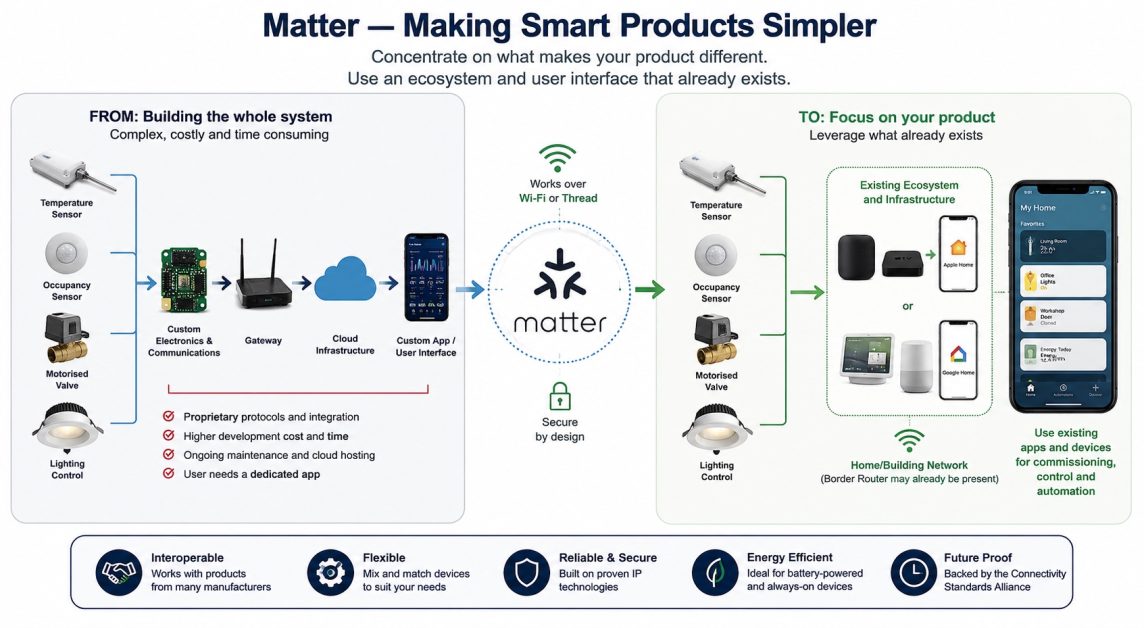
Many electronic products now need to be connected, monitored or controlled as part of a wider system. Until recently, that could mean developing not only the product itself, but also the communications infrastructure, a user interface and sometimes a cloud service.
Matter offers another approach.
By designing a sensor, actuator or control unit to work within the Matter ecosystem, manufacturers can use established platforms such as Apple Home and Google Home, running on smartphones and other devices, for commissioning, control and automation. This allows engineering effort to be concentrated on the part of the product that actually differentiates it, while taking advantage of an ecosystem and user interface that already exists.
What is Matter?
Matter is an industry standard designed to allow compatible connected products from different manufacturers to work together.
Rather than a manufacturer having to develop a complete proprietary system, a Matter-compatible device can become part of an established ecosystem. Users can add devices, monitor and control them, and create automations using familiar interfaces such as Apple Home or Google Home.
Importantly, Matter is not tied to one phone or equipment manufacturer. Compatible devices from different suppliers can work together within the same system, reducing dependence on proprietary hardware and software.
Concentrate on the part that adds value
Consider a manufacturer developing a specialist environmental sensor.
Traditionally, the sensor itself might be only one part of the development. The complete product could also require communications hardware and software, a gateway, a dedicated user interface or app and perhaps supporting cloud infrastructure.
With Matter, much of that wider ecosystem already exists.
Engineering effort can therefore be concentrated on what makes the product different — perhaps the sensing technology, accuracy, packaging, power consumption, environmental protection or specialist application knowledge.
The same principle applies to actuators and control products: switches, valves, motors, lighting controls, ventilation equipment and many other devices.
Why reinvent the whole system when much of it already exists?
It just needs packaging differently.
What if the device you need doesn’t exist?
An increasing range of Matter-compatible sensors and actuators are already available off-the-shelf. But sometimes the particular device required for a specific application simply doesn’t exist. Perhaps a sensor needs to measure an unusual parameter, operate in a difficult environment or interface with existing equipment. An actuator may require a particular mechanical arrangement, power output or control function. This is where custom electronics can fill the gap.
Arrow Technical can design and manufacture a specialist sensor, actuator or control unit where a suitable standard product isn’t available. Matter compatibility can then allow that custom device to become part of a much wider established system without having to develop the complete system from scratch.
Not just for the home
Although Matter is commonly associated with home automation, the same approach can be useful in commercial environments such as shops, offices, workshops, restaurants and small industrial units.
Applications could include:
- environmental monitoring;
- occupancy sensing;
- lighting and heating control;
- ventilation;
- refrigeration monitoring;
- energy measurement;
- water-leak detection;
- doors, shutters and other security-related functions.
A small business may not need the complexity or expense of a conventional Building Management System, but could still benefit considerably from automatic monitoring and control — particularly where ease of setup, low-cost, energy saving, security or early detection of problems provides a clear financial benefit.
Matter and connectivity
Matter can operate over familiar IP networking technologies including Wi-Fi and Thread. Thread is a low-power wireless mesh technology particularly suited to embedded devices such as battery-powered sensors, and the necessary network infrastructure may already exist in products such as Apple HomePod, Apple TV and compatible Google Nest devices. For many users, however, the underlying technology can remain largely invisible — they simply add a compatible device to their existing system and use the interface they already know. They don’t need to concern themselves how it works – they can rely on the fact that it just does.
Easier doesn’t mean no engineering
Matter doesn’t make every electronic device automatically compatible with every automation platform. Products still need to be properly designed around supported Matter device types and functions, with appropriate consideration given to communications, security, firmware, certification and product reliability.
For unusual applications, additional integration may still be required and specialists, like Arrow Technical are there to help when unusual appears to be impossible.
But compared with developing an entirely proprietary connected-product ecosystem, Matter can substantially change where the engineering effort needs to be spent.
Could Matter simplify your next product?
If you are developing a sensor, actuator or control product — or have an application where the device you need simply isn’t available off the shelf or making it work is proving too challenging to handle internally — talk to Arrow Technical.
There may be an opportunity to develop the specialist hardware and software your application requires while using Matter and established automation platforms to provide much of the wider system around it.
Concentrate your development effort on what makes your product different — and take advantage of what already exists to get effective solutions to market before anybody else does.